Artificial Intelligence Experience Optimization (AIEO) - Why SEO alone is no longer enough
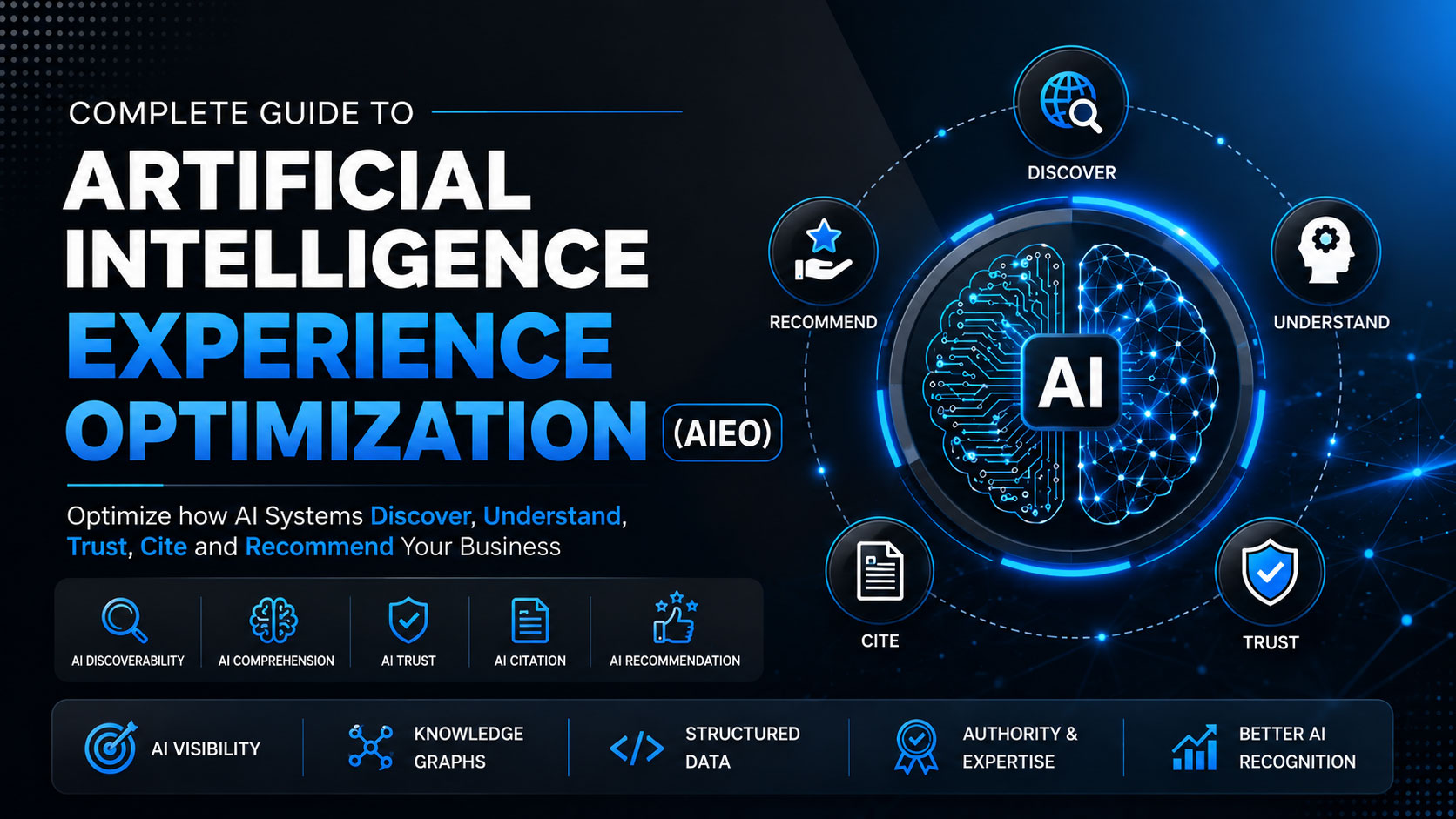
Artificial Intelligence Experience Optimization (AIEO) is the practice of optimizing how artificial intelligence systems discover, understand, validate, trust, cite, and recommend a business across AI-powered search experiences, large language models, answer engines, AI assistants, and generative platforms. While Search Engine Optimization (SEO) focuses on improving visibility within search results, AIEO focuses on improving how AI systems perceive, interpret, and represent a business when generating answers for users.
As artificial intelligence becomes a primary gateway to information discovery, businesses are entering a new era of digital visibility. Success is no longer determined solely by rankings and clicks. Increasingly, it depends on whether AI systems understand who you are, what you do, why you are credible, and whether your information deserves to be included in AI-generated responses.
Key Takeaways
- AIEO focuses on optimizing how AI systems understand and represent a business.
- Modern digital visibility increasingly depends on AI-generated answers and recommendations.
- Entity recognition is becoming more important than keyword matching.
- Knowledge graphs help AI systems understand business relationships and credibility.
- Structured information improves machine comprehension and retrieval accuracy.
- AIEO complements SEO, GEO, AEO, content strategy, and technical optimization.
- Organizations that optimize for AI experiences today may gain long-term competitive advantages.
- The future of visibility extends beyond rankings into AI trust and AI recommendation systems.
What is Artificial Intelligence Experience Optimization?
Artificial Intelligence Experience Optimization is a strategic discipline focused on improving how artificial intelligence systems experience a business. The concept is based on a simple observation: before AI can recommend, summarize, compare, or cite a business, it must first understand that business.
Traditional optimization strategies were designed primarily for search engines that ranked webpages. Today's AI systems operate differently. They evaluate context, identify entities, verify facts, establish relationships, and synthesize information from multiple sources before generating answers.
AIEO helps organizations ensure that AI systems can accurately interpret their expertise, products, services, authority, and brand identity.
Rather than optimizing only for search visibility, Artificial Intelligence Experience Optimization focuses on optimizing for AI understanding.
Why Search Engine Optimization Alone Is No Longer Enough
For more than twenty years, businesses improved online visibility by optimizing websites for search engines. Keyword targeting, content creation, backlinks, and technical SEO became the foundations of digital marketing.
These practices remain valuable. However, the way people discover information is changing rapidly.
Users now ask AI assistants for recommendations, comparisons, explanations, product advice, service providers, and purchasing guidance. Instead of reviewing multiple webpages, they increasingly expect complete answers from a single AI-generated response.
This shift introduces a new challenge.
A website can rank highly in search engines and still remain largely invisible within AI-generated answers if AI systems lack sufficient confidence in the information available.
The Evolution of Digital Discovery
Digital discovery has evolved through several distinct stages. Understanding this progression helps explain why Artificial Intelligence Experience Optimization is becoming increasingly important.
| Digital Era | Primary Discovery Method | User Behavior |
|---|---|---|
| Directory Era | Web directories | Browse categories manually |
| Search Era | Search engines | Keyword-based searching |
| Mobile Era | Apps and search | Instant information access |
| Social Era | Feeds and recommendations | Content-driven discovery |
| AI Era | AI-generated answers | Conversational discovery |
The AI Era changes the role of optimization entirely. Rather than helping users find information, businesses increasingly need to help AI systems understand information.
What Is an AI Experience?
An AI experience occurs whenever artificial intelligence acts as an intermediary between a user and information. Instead of interacting directly with websites, users interact with AI systems that evaluate information on their behalf.
These experiences occur across conversational assistants, AI search engines, answer engines, recommendation systems, customer support agents, and generative AI platforms.
This creates a new audience that businesses must optimize for: artificial intelligence itself.
| Traditional Human Experience | Artificial Intelligence Experience |
|---|---|
| User visits website | AI accesses information |
| User reads content | AI extracts facts |
| User evaluates credibility | AI evaluates trust signals |
| User compares providers | AI compares entities |
| User makes decisions | AI generates recommendations |
Artificial Intelligence Experience Optimization helps ensure that AI systems can complete these tasks accurately and confidently.
Important Definitions in Artificial Intelligence Experience Optimization
Artificial Intelligence (AI)
Artificial Intelligence refers to computer systems capable of performing tasks that normally require human intelligence, including learning, reasoning, language understanding, and decision-making.
Large Language Model (LLM)
A Large Language Model is an AI system trained on vast amounts of text data to understand and generate natural language responses.
Entity
An entity is a uniquely identifiable person, company, organization, location, product, service, or concept recognized by AI systems.
Knowledge Graph
A knowledge graph is a structured network of entities and relationships that helps machines understand context, meaning, and connections.
AI Citation
An AI citation occurs when an artificial intelligence system references information from a specific source while generating an answer.
Answer Engine Optimization (AEO)
Answer Engine Optimization focuses on structuring information so answer engines can provide direct responses to user questions.
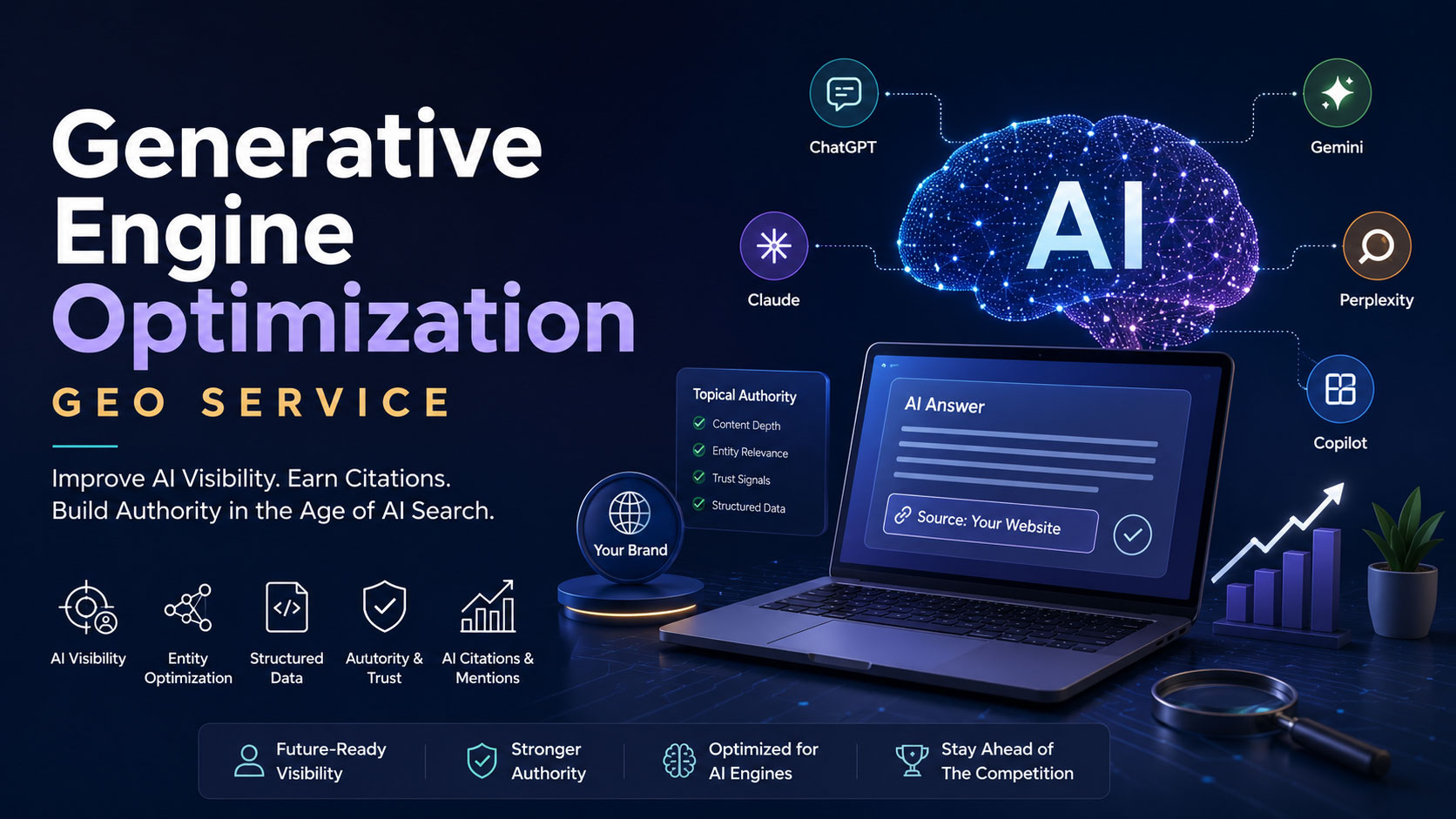
Generative Engine Optimization (GEO)
Generative Engine Optimization focuses on improving visibility within AI-generated responses and conversational search experiences.
Entity Optimization
Entity Optimization is the process of helping AI systems clearly identify, understand, and associate information with a specific business, person, product, or organization.
Semantic Understanding
Semantic understanding refers to the ability of AI systems to interpret meaning, context, and relationships beyond exact keyword matches.
The Shift from Search Visibility to AI Visibility
One of the most significant developments in digital marketing is the transition from search visibility to AI visibility.
Historically, organizations competed for positions within search engine result pages. Performance was measured using rankings, impressions, clicks, and traffic.
Today, businesses increasingly compete for inclusion within AI-generated answers, AI recommendations, AI citations, and conversational experiences.
This transition introduces new optimization priorities.
- Can AI systems discover your business?
- Can AI systems understand what your business does?
- Can AI systems verify your expertise?
- Can AI systems trust your information?
- Will AI systems cite your content?
- Will AI systems recommend your services?
Artificial Intelligence Experience Optimization provides a framework for addressing each of these questions systematically.
Why Artificial Intelligence Experience Optimization Matters
Artificial Intelligence Experience Optimization is not a replacement for SEO. Instead, it expands optimization efforts beyond traditional search engines and prepares organizations for a future where AI systems increasingly mediate information discovery.
Businesses that understand how artificial intelligence evaluates information can improve not only search visibility but also answer visibility, recommendation visibility, citation visibility, and AI trust visibility.
As AI continues to influence consumer decisions, organizations that invest in AIEO may gain meaningful advantages in discoverability, credibility, and digital authority.
The Five Layers of Artificial Intelligence Experience Optimization™
Artificial Intelligence Experience Optimization is most effective when approached as a structured framework rather than a collection of isolated tactics. Through our research and observations of emerging AI ecosystems, we have identified five foundational layers that influence how artificial intelligence systems perceive, evaluate, and represent a business.
Each layer builds upon the previous one. Without discoverability there can be no understanding. Without understanding there can be no trust. Without trust there can be no citation. Without citation there can be no recommendation.
| Layer | Objective | Key Outcome |
|---|---|---|
| Layer 1 | AI Discoverability | AI systems can find your information |
| Layer 2 | AI Comprehension | AI systems understand your business |
| Layer 3 | AI Trust | AI systems validate credibility |
| Layer 4 | AI Citation | AI systems reference your information |
| Layer 5 | AI Recommendation | AI systems recommend your business |
Layer 1: AI Discoverability
The first challenge is ensuring that AI systems can discover information about a business. This includes website accessibility, crawlability, structured content architecture, schema implementation, entity consistency, and publicly available knowledge sources.
If information cannot be discovered, no further optimization efforts can succeed.
Layer 2: AI Comprehension
Once information is discovered, AI systems must understand it. This involves clear content structures, semantic organization, entity definitions, relationship mapping, and topic clarity.
Organizations that communicate expertise clearly are easier for AI systems to interpret accurately.
Layer 3: AI Trust
AI systems continuously evaluate trust signals. Consistency across websites, citations, social profiles, structured data, publications, and external references contributes to AI confidence.
Trust is often the deciding factor between information being ignored and information being utilized.
Layer 4: AI Citation
AI systems prefer referencing information they can confidently validate. Well-structured content, authoritative resources, factual accuracy, and comprehensive coverage increase citation potential.
Being cited by AI systems is becoming the modern equivalent of earning visibility in search results.
Layer 5: AI Recommendation
The highest level of Artificial Intelligence Experience Optimization occurs when AI systems actively recommend a business, service, solution, or resource as part of generated responses.
This represents the culmination of discoverability, comprehension, trust, and citation working together.
The AI Trust Graph Framework™
One of the most important concepts within Artificial Intelligence Experience Optimization is the AI Trust Graph. This framework illustrates how AI systems gradually build confidence in a business through interconnected signals.
Website Content
↓
Structured Data
↓
Entity Recognition
↓
Knowledge Relationships
↓
Authority Signals
↓
AI Trust
↓
AI Citation
↓
AI Recommendation
Each stage reinforces the next. Weakness at any point can reduce overall AI confidence. Businesses that invest in all layers of the trust graph create stronger AI visibility foundations.
AIEO vs SEO vs GEO vs AEO
Many organizations are encountering multiple optimization acronyms and frameworks simultaneously. While these disciplines overlap, they serve different objectives.
| Framework | Primary Goal | Primary Audience |
|---|---|---|
| SEO | Rank webpages | Search engines |
| AEO | Answer user questions | Answer engines |
| GEO | Influence AI-generated responses | Generative AI platforms |
| AIEO | Optimize entire AI perception | All AI systems |
Artificial Intelligence Experience Optimization sits above these disciplines as a broader strategic framework. It encompasses search visibility, answer visibility, citation visibility, recommendation visibility, and machine understanding.
Original Research and RiAcube Observations
As AI-powered search and conversational experiences continue evolving, several patterns have emerged regarding how AI systems evaluate information quality and authority.
| Observation | Impact on AI Visibility |
|---|---|
| Strong Entity Signals | Improve business recognition |
| Comprehensive Topic Coverage | Strengthens expertise perception |
| Schema Implementation | Improves machine understanding |
| Consistent Business Information | Increases AI trust |
| Question-Based Content | Improves answer retrieval |
| Authority References | Enhances citation opportunities |
What Does an Artificial Intelligence Experience Optimization Service Include?
An effective AIEO strategy requires a combination of technical optimization, content engineering, entity development, and trust signal enhancement.
Unlike traditional SEO campaigns that focus primarily on rankings, AIEO initiatives focus on how AI systems interpret and utilize information.
Entity Optimization
Entity optimization establishes clear machine-readable identities for businesses, products, services, and subject matter expertise.
Knowledge Graph Development
Knowledge graph optimization strengthens relationships between entities, topics, services, and authoritative information sources.
Structured Data Architecture
Schema implementation helps AI systems understand organizational information, services, expertise, authorship, and content relationships.
AI Citation Optimization
Content structures are designed to improve the likelihood of AI systems referencing information during answer generation.
Semantic Content Engineering
Content is organized around concepts, relationships, intent, and topical completeness rather than keywords alone.
Authority Development
Trust-building signals are strengthened through expertise demonstration, consistency, citations, references, and authoritative content creation.
Generative Engine Optimization (GEO)
Content is optimized for visibility within AI-generated search experiences and conversational discovery platforms.
Answer Engine Optimization (AEO)
Question-based content structures improve retrieval and answer generation opportunities.
How Much Does Artificial Intelligence Experience Optimization Cost?
The cost of Artificial Intelligence Experience Optimization varies depending on business size, industry competitiveness, digital maturity, content requirements, and existing authority signals.
Unlike traditional SEO, AIEO often involves broader strategic initiatives including entity development, structured data implementation, knowledge graph enhancement, content architecture, and AI trust optimization.
| Business Type | Typical AIEO Scope |
|---|---|
| Small Business | Entity optimization, schema implementation, foundational content improvements |
| Growing Business | Authority development, topical expansion, AI citation optimization |
| Enterprise Organization | Full-scale AI visibility strategy, knowledge graph development, entity ecosystem management |
Expert Perspective: The Future of Digital Visibility
Artificial Intelligence Experience Optimization represents a natural evolution of digital marketing. As AI systems become increasingly responsible for information discovery, recommendation generation, and decision support, organizations must optimize for both human audiences and machine understanding.
The businesses that succeed in the coming years are likely to be those that establish clear entities, strong knowledge relationships, authoritative expertise, and trustworthy information ecosystems.
The future of visibility is not simply being found. It is being understood.
Why Trust RiAcube?
RiAcube combines software engineering expertise, technical problem-solving capabilities, digital marketing experience, and structured data implementation knowledge to help organizations prepare for the future of AI-driven discovery.
Our team understands that Artificial Intelligence Experience Optimization extends beyond traditional SEO. It requires a deeper understanding of machine-readable content, entity relationships, knowledge architecture, information systems, and AI trust signals.
By combining development expertise with modern search and AI optimization methodologies, RiAcube helps organizations build stronger foundations for long-term digital visibility.
- Experience in software development and internet technologies.
- Expertise in structured data and technical implementation.
- Knowledge of SEO, GEO, AEO, and emerging AI visibility strategies.
- Focus on scalable, future-ready optimization frameworks.
- Commitment to building authoritative digital knowledge ecosystems.
Conclusion: Preparing for the Age of AI Visibility
Artificial Intelligence Experience Optimization (AIEO) represents the next stage in the evolution of digital visibility. While traditional SEO remains important, businesses must increasingly consider how artificial intelligence systems discover, interpret, trust, and recommend information.
Organizations that invest in strong entity development, structured information architecture, authoritative content, knowledge graph optimization, and AI trust signals position themselves for long-term success in an AI-driven digital landscape.
The future of online visibility is not simply about being indexed or ranked. It is about being understood, trusted, cited, and recommended by the systems that increasingly shape how people discover information.
Frequently Asked Questions (FAQs)
What is Artificial Intelligence Experience Optimization (AIEO)?
Artificial Intelligence Experience Optimization (AIEO) is the practice of optimizing digital assets, entities, structured data, authority signals, and content so AI systems can accurately understand, trust, cite, and recommend a business.
How is AIEO different from SEO?
SEO focuses on improving rankings in search engines, while AIEO focuses on improving how artificial intelligence systems perceive, interpret, validate, and represent a business across AI-powered experiences.
Does AIEO replace SEO?
No. AIEO complements SEO. Search engines remain important, but businesses should also optimize for AI systems that increasingly influence information discovery and purchasing decisions.
What are the benefits of Artificial Intelligence Experience Optimization?
Benefits may include improved AI visibility, stronger entity recognition, greater citation opportunities, enhanced authority signals, improved trustworthiness, and increased likelihood of appearing in AI-generated recommendations.
Who needs Artificial Intelligence Experience Optimization?
Businesses, organizations, professionals, publishers, software companies, eCommerce stores, educational institutions, and service providers can all benefit from improving how AI systems understand and represent their information.
What technologies support AIEO?
AIEO commonly involves structured data, schema markup, entity optimization, knowledge graphs, semantic content architecture, technical SEO, GEO, AEO, and AI trust signal development.
How long does AIEO take to show results?
The timeline varies depending on competition, industry, authority, content quality, and existing digital presence. Artificial Intelligence Experience Optimization should generally be viewed as a long-term strategic investment.
Source References
- Google Search Central Documentation
- Schema.org Documentation
- OpenAI Documentation
- Microsoft AI and Copilot Documentation
- Google AI Overview Resources
- W3C Structured Data Standards
- Knowledge Graph Research Publications
- Natural Language Processing (NLP) Research Papers
Explore More AI Search Optimization Strategies
Learn how modern search technologies are evolving and explore proven strategies to improve rankings, AI citations, answer engine visibility, and online authority.
 Have a project idea? Let’s discuss.