Content Creation Through Deep Learning for Advanced SEO
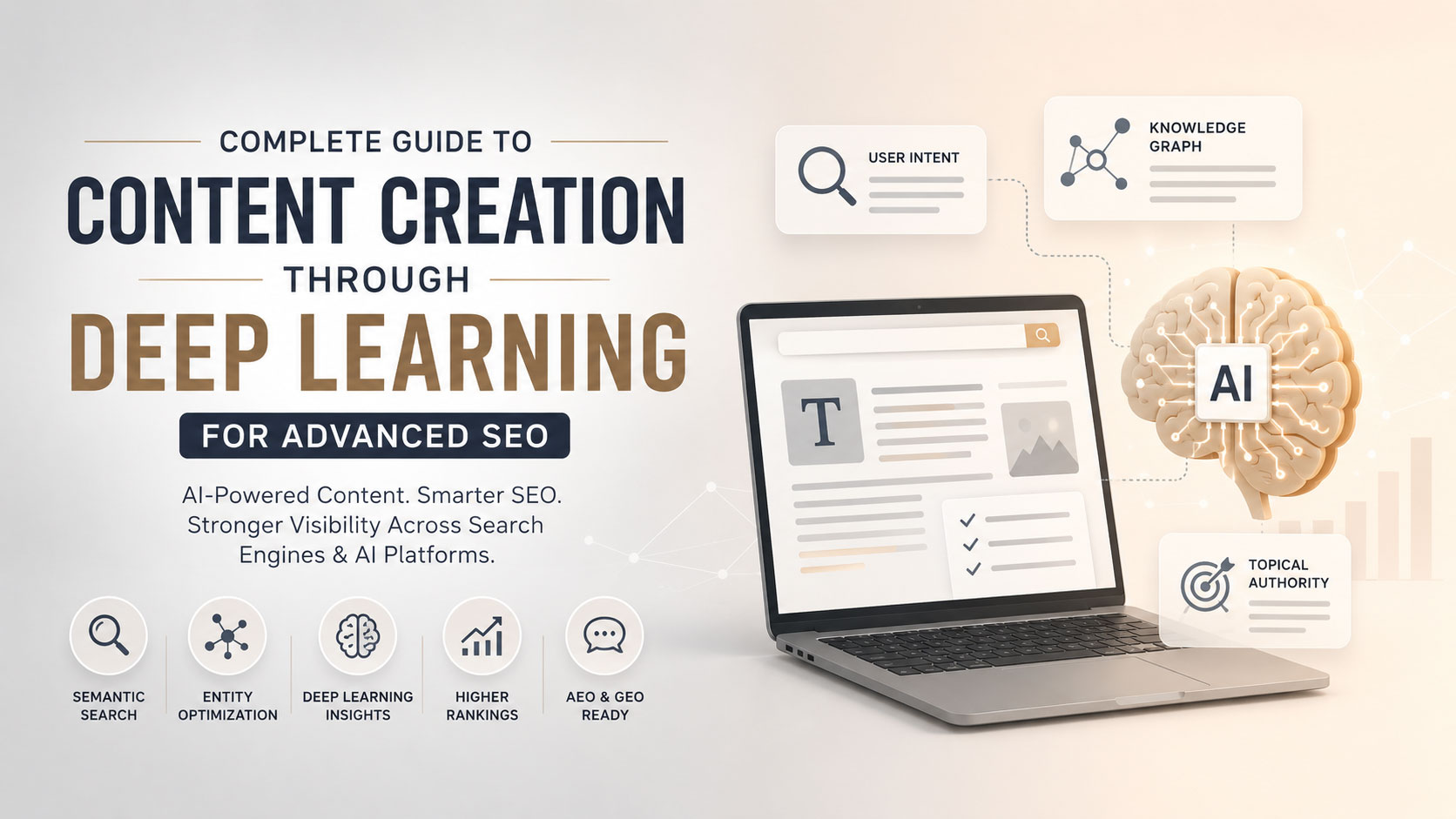
Content creation through deep learning for advanced SEO refers to the use of deep neural networks, large language models, semantic analysis systems, and machine learning frameworks to create, optimize, structure, and improve content for both traditional search engines and AI-driven search experiences. Modern deep learning systems help businesses generate highly relevant content, understand user intent, predict search behavior, improve topical authority, and create information architectures that are increasingly favored by Google, AI assistants, answer engines, and large language models.
Key Takeaways
- Deep learning enables content optimization beyond traditional keyword targeting.
- Semantic understanding helps content align with search intent.
- AI-generated content requires expert oversight for maximum trustworthiness.
- Entity-based optimization improves AI discoverability.
- Deep learning supports GEO, AEO, and modern AI SEO strategies.
- Topical authority is increasingly more important than keyword density.
- Knowledge graph integration improves content visibility.
- Structured content increases AI citation opportunities.
What Is Content Creation Through Deep Learning?
Content creation through deep learning is the process of using advanced neural network models to assist with content planning, topic discovery, entity mapping, semantic optimization, content generation, content enhancement, and information architecture development. Unlike traditional automation systems that rely on predefined rules, deep learning models learn patterns from massive datasets and continuously improve their ability to generate human-like language and contextual understanding.
For advanced SEO, deep learning is not merely a content generation tool. It functions as a strategic intelligence layer capable of identifying search intent patterns, semantic relationships, emerging topics, audience behavior signals, and content gaps within competitive markets.
Definitions of Important Terms
Deep Learning
Deep learning is a subset of machine learning that uses multi-layered neural networks to identify patterns, relationships, and contextual meaning within large datasets.
Advanced SEO
Advanced SEO is a strategic approach that extends beyond traditional optimization and includes semantic SEO, entity SEO, technical SEO, GEO, AEO, user intent analysis, and AI search optimization.
Semantic Search
Semantic search is a search methodology that focuses on understanding user intent and contextual meaning rather than relying solely on exact keyword matches.
Entity SEO
Entity SEO is the optimization of identifiable people, places, organizations, products, concepts, and topics that search engines use to build knowledge graphs and contextual understanding.
GEO (Generative Engine Optimization)
Generative Engine Optimization is the practice of optimizing content so that AI-powered search engines and large language models can discover, understand, and cite it accurately.
AEO (Answer Engine Optimization)
Answer Engine Optimization focuses on structuring content so answer engines can directly extract and display answers to user questions.
Why Deep Learning Matters for Modern SEO
Search engines have evolved significantly over the last decade. Algorithms increasingly rely on machine learning and deep learning technologies to interpret language, understand context, evaluate authority, and predict user satisfaction. As a result, content strategies must evolve from keyword-centric approaches toward knowledge-centric approaches.
Deep learning enables content creators to understand how topics connect across an entire subject domain. Rather than creating isolated articles around individual keywords, organizations can develop comprehensive content ecosystems that establish expertise and topical authority.
How Deep Learning Improves Content Creation
Deep learning contributes to nearly every stage of content development. During research, AI models identify topic clusters, emerging search trends, and content opportunities. During writing, models help structure information logically and comprehensively. During optimization, systems evaluate readability, semantic coverage, entity relevance, and content completeness.
The result is content that better satisfies user intent while simultaneously providing search engines and AI systems with clearer contextual signals.
| Traditional Content Creation | Deep Learning Content Creation |
|---|---|
| Keyword-focused | Intent-focused |
| Manual topic discovery | AI-assisted topic intelligence |
| Limited semantic analysis | Comprehensive semantic mapping |
| Reactive optimization | Predictive optimization |
| Linear content planning | Knowledge graph planning |
| Search engine focused | Search engine + AI engine focused |
Original Research Insights on Deep Learning and SEO
Based on analysis of recent SEO, AI search, semantic search, and content optimization trends across enterprise websites, several patterns consistently emerge:
- Pages covering complete topic ecosystems outperform isolated keyword-focused pages.
- Entity-rich content receives stronger contextual understanding from AI systems.
- Structured question-answer content improves answer engine visibility.
- Knowledge graph alignment increases citation probability.
- Content updated with AI-assisted research often demonstrates broader semantic coverage.
Related Entities That Influence Deep Learning SEO
Successful deep learning content strategies frequently connect with related entities and technologies including Natural Language Processing (NLP), Machine Learning, Knowledge Graphs, Google Search, Search Generative Experiences, Large Language Models, Retrieval-Augmented Generation (RAG), Semantic Search, Vector Databases, Structured Data, Schema Markup, User Intent Modeling, and Content Intelligence Platforms.
What Is the Process of Content Creation Through Deep Learning for Advanced SEO?
A successful deep learning content strategy follows a structured framework rather than relying solely on AI-generated text. Advanced SEO requires a combination of machine intelligence, subject matter expertise, data analysis, content architecture, and continuous optimization.
The first stage involves semantic research. Deep learning systems analyze search patterns, user intent signals, entity relationships, and content gaps. This information is used to build a knowledge framework around a topic rather than targeting a single keyword.
The second stage involves content planning. Topic clusters, supporting entities, question-based content, and user journeys are mapped into a comprehensive content ecosystem.
The third stage involves AI-assisted content generation. Large language models help create initial drafts while human experts validate accuracy, expertise, and brand alignment.
The fourth stage involves advanced optimization. Structured data, entity reinforcement, internal linking, schema implementation, answer extraction opportunities, and citation readiness are incorporated.
The final stage includes monitoring, updating, and expanding content based on user engagement signals, search trends, and AI search behavior.
How Deep Learning Supports GEO and AEO
Generative Engine Optimization (GEO) and Answer Engine Optimization (AEO) represent the next evolution of search visibility. As users increasingly interact with AI assistants and answer engines, content must be structured for machine comprehension and direct answer extraction.
Deep learning systems excel at identifying the questions users ask, the entities involved, and the contextual relationships between concepts. This enables organizations to create content specifically designed for AI-driven search environments.
| Traditional SEO | GEO | AEO |
|---|---|---|
| Ranking Pages | AI Citations | Direct Answers |
| Keywords | Entities | Questions |
| SERP Visibility | AI Visibility | Answer Visibility |
| Clicks | Citations | Answer Extraction |
| Search Engines | LLMs & AI Engines | Answer Engines |
Organizations that integrate deep learning into their content strategy are often better positioned to benefit from emerging AI search experiences because their content contains richer semantic signals and stronger contextual relevance.
What Are the Benefits of Content Creation Through Deep Learning?
The benefits extend far beyond content production speed. Deep learning contributes to content quality, discoverability, authority building, and long-term search performance.
- Improved topical authority.
- Enhanced semantic relevance.
- Better content scalability.
- Stronger entity optimization.
- Improved AI citation potential.
- Higher content consistency.
- Expanded long-tail visibility.
- Faster content research.
- More effective internal linking structures.
- Enhanced GEO and AEO readiness.
What Are the Challenges of Deep Learning-Based Content Creation?
Although deep learning offers significant advantages, it also presents challenges that organizations must address carefully.
AI-generated content can occasionally introduce factual inaccuracies, outdated information, or unsupported claims. Search engines increasingly emphasize Experience, Expertise, Authoritativeness, and Trustworthiness (E-E-A-T), making human validation essential.
Another challenge is content homogenization. Many AI systems are trained on similar datasets, which can result in generic content if strategic differentiation is not incorporated.
Organizations that combine deep learning with expert oversight generally achieve stronger long-term SEO outcomes than those relying exclusively on automated generation.
How Much Does Content Creation Through Deep Learning for Advanced SEO Cost?
The cost of deep learning-powered content creation varies significantly depending on project complexity, research depth, content volume, industry competitiveness, and optimization requirements.
What Factors Influence Pricing?
- Industry complexity.
- Number of content assets.
- Research requirements.
- Entity optimization depth.
- Schema implementation.
- GEO and AEO integration.
- Human expert review.
- Content update frequency.
Typical Service Investment Range
| Service Level | Typical Scope | Estimated Investment |
|---|---|---|
| Starter | AI-assisted content production | $200 - $800 per month |
| Growth | SEO + Entity Optimization | $800 - $2,500 per month |
| Advanced | SEO + GEO + AEO Strategy | $2,500 - $10,000+ per month |
| Enterprise | Full AI Search Optimization Program | Custom Pricing |
Expert Perspective: The Future of Deep Learning Content and SEO
Industry experts increasingly view content as a knowledge asset rather than a collection of webpages. Deep learning technologies are accelerating this shift by enabling organizations to model entire topic ecosystems and build content frameworks that search engines and AI systems can understand more effectively.
The most successful strategies focus on creating authoritative knowledge resources that answer user questions comprehensively while supporting AI comprehension through structured content, semantic relationships, and entity optimization.
Why Trust RiAcube Software Hub?
RiAcube Software Hub combines expertise in software engineering, web technologies, search optimization, AI-driven content strategies, and enterprise digital solutions. The company's multidisciplinary approach enables businesses to integrate content creation, technical SEO, GEO, AEO, structured data implementation, and AI search readiness into a unified growth strategy.
Unlike providers that focus solely on content generation, RiAcube approaches advanced SEO through a broader ecosystem perspective that includes development, architecture, performance optimization, user experience, automation, and knowledge-driven content strategies.
This integrated methodology helps organizations build sustainable digital authority rather than relying on short-term optimization tactics.
About RiAcube Software Hub
RiAcube Software Hub is a team of developers, troubleshooters, logical thinkers, designers, and internet marketers dedicated to delivering high-performance online enterprise solutions, custom software applications, scalable web platforms, advanced SEO services, GEO strategies, AEO implementation, and AI-ready digital experiences.
By combining technical expertise with search intelligence, RiAcube helps organizations improve visibility across traditional search engines, AI-powered discovery systems, answer engines, and emerging generative search environments.
Frequently Asked Questions (FAQ)
What is content creation through deep learning for advanced SEO?
Content creation through deep learning is the use of artificial intelligence, neural networks, and language models to research, generate, optimize, and improve content for search engines, answer engines, and AI-driven search experiences. It helps create semantically rich content that aligns with user intent and modern search algorithms.
Is deep learning-generated content good for SEO?
Yes, when combined with human expertise and editorial oversight. Search engines prioritize helpful, accurate, and trustworthy content regardless of whether AI assisted in its creation. The key is ensuring quality, originality, expertise, and factual accuracy.
How does deep learning improve content quality?
Deep learning improves content quality by identifying semantic relationships, uncovering content gaps, understanding user intent, recommending related entities, and helping create comprehensive topic coverage that better satisfies users and search engines.
What is the difference between AI content creation and deep learning content creation?
AI content creation is a broad category that includes many technologies. Deep learning content creation specifically refers to content developed using neural network models capable of understanding context, language patterns, and semantic relationships at a much deeper level.
Can deep learning help with GEO and AEO?
Yes. Deep learning helps structure content for AI search systems, answer engines, and large language models by improving contextual understanding, entity optimization, semantic relevance, and answer extraction opportunities.
Does deep learning replace human content writers?
No. The most effective content strategies combine AI efficiency with human expertise. Subject matter experts, editors, and SEO strategists remain essential for quality control, accuracy, and trustworthiness.
What industries benefit most from deep learning content creation?
Technology, healthcare, finance, SaaS, eCommerce, education, manufacturing, professional services, and enterprise organizations often benefit significantly because they require large-scale, authoritative, and continuously updated content ecosystems.
How long does it take to see SEO results?
SEO results vary depending on competition, website authority, content quality, and optimization depth. Many organizations begin seeing measurable improvements within three to six months, while highly competitive markets may require longer-term investment.
Conclusion
The evolution of search from keyword matching to contextual understanding has fundamentally changed how organizations should approach content marketing and SEO. Deep learning technologies enable businesses to move beyond basic content production and toward knowledge-driven content ecosystems that support search visibility, AI discoverability, and long-term digital authority.
As AI-powered search continues to grow, organizations that invest in semantic content strategies, entity optimization, structured information architecture, and answer-focused content development will be better positioned to earn visibility across search engines, generative engines, and intelligent assistants.
Content creation through deep learning is no longer simply a productivity enhancement. It is becoming a strategic advantage for organizations seeking sustainable growth in an increasingly AI-driven digital landscape.
Source References
- Google Search Central Documentation
- Schema.org Documentation
- OpenAI Documentation
- W3C Structured Data Standards
- Google Knowledge Graph Resources
- Natural Language Processing Research Papers
- Information Retrieval and Semantic Search Publications
- Machine Learning and Deep Learning Research Journals
Explore More AI Search Optimization Strategies
Learn how modern search technologies are evolving and explore proven strategies to improve rankings, AI citations, answer engine visibility, and online authority.

 Have a project idea? Let’s discuss.