Keywords to LLM Search Intelligence - AI-readable knowledge structures that improve discoverability
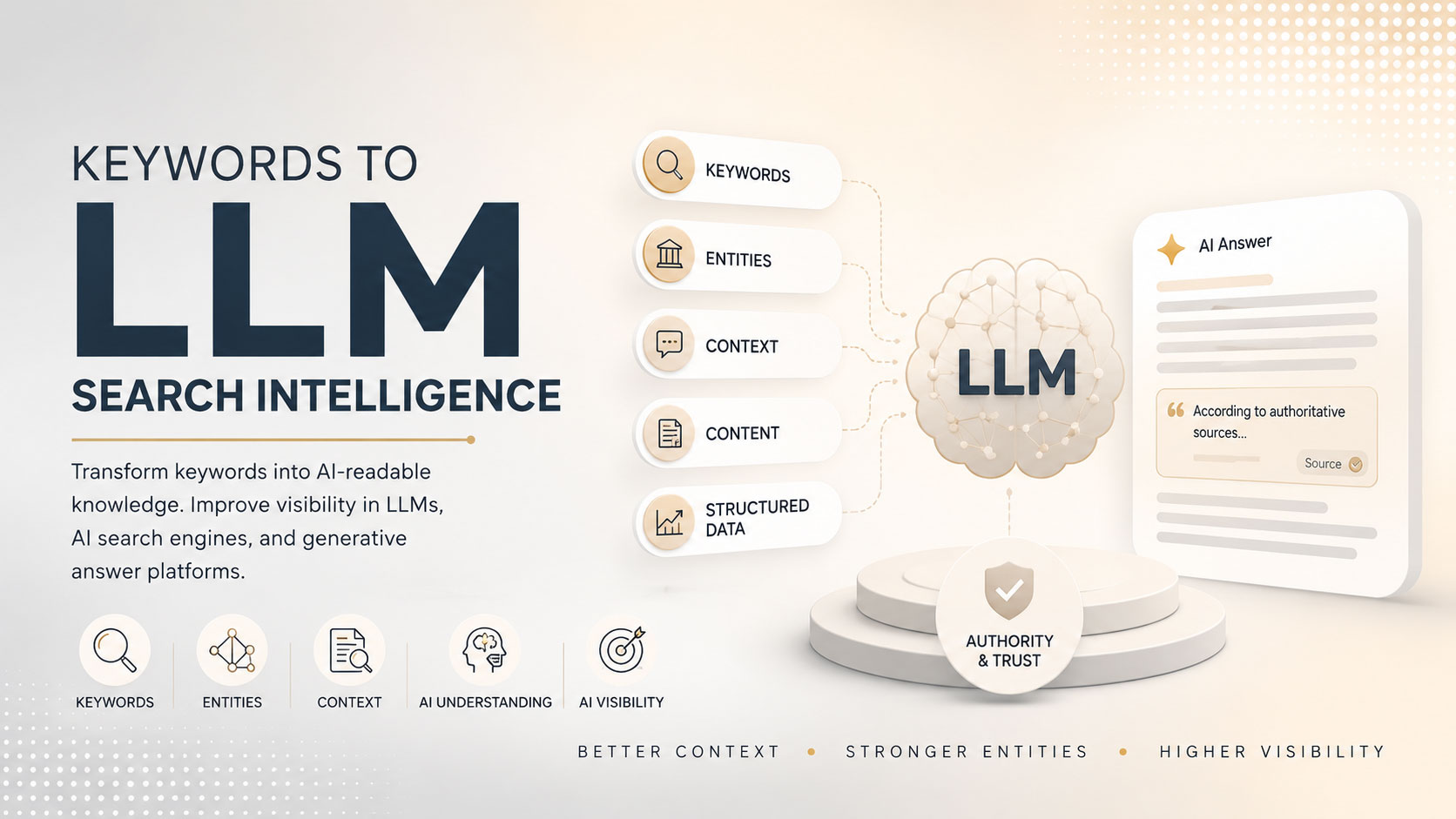
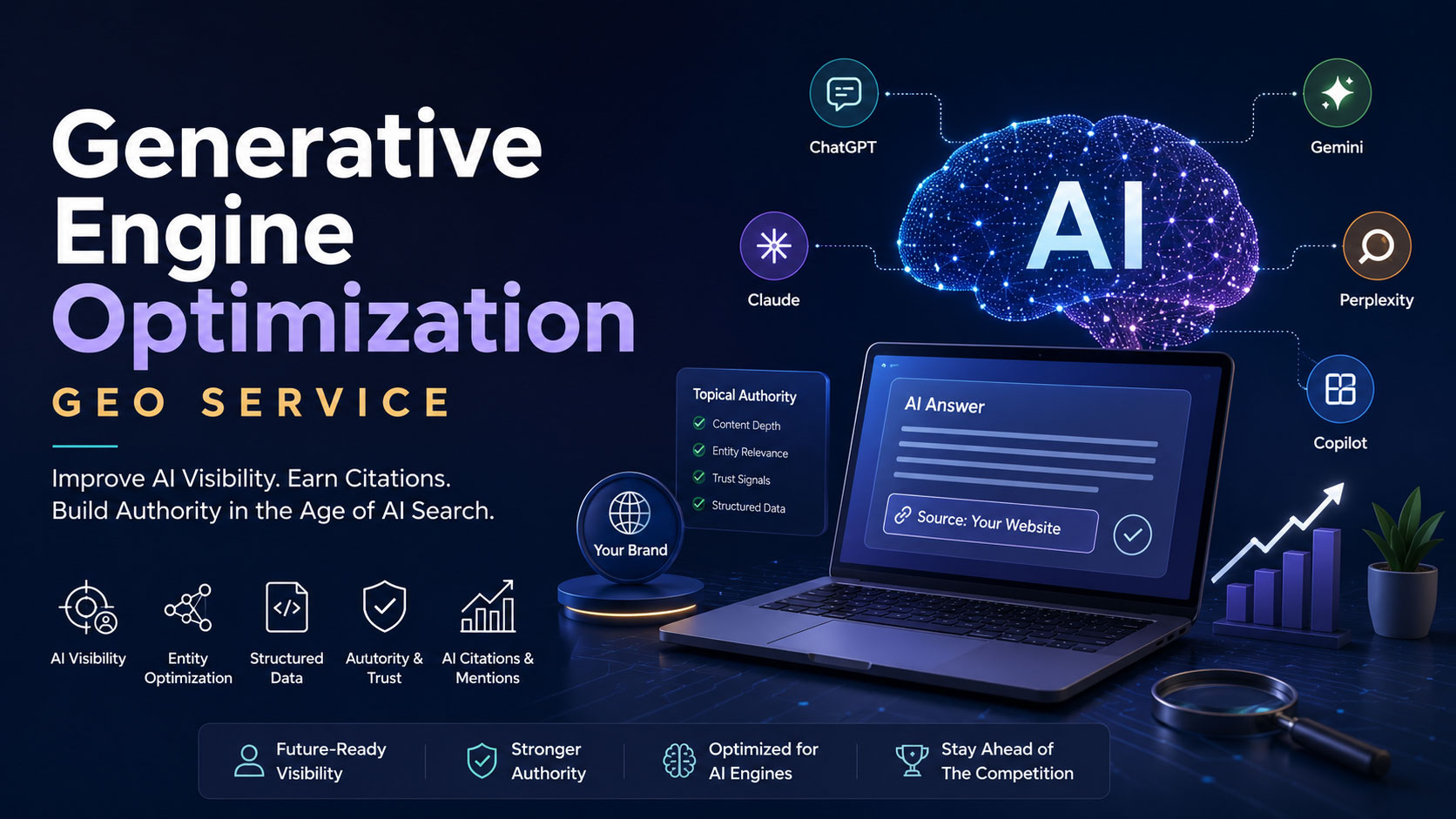
Keywords to LLM Search Intelligence is the process of transforming traditional keyword-focused SEO strategies into entity-driven, context-aware, AI-readable content systems that large language models (LLMs) can understand, retrieve, cite, summarize, and recommend. Instead of optimizing only for search engine rankings, Keywords to LLM Search Intelligence focuses on helping AI systems such as ChatGPT, Gemini, Claude, Perplexity, and Copilot identify a brand as an authoritative answer source. This approach combines keyword research, semantic relationships, entity mapping, structured data, retrieval optimization, topical authority, and AI citation engineering.
Key Takeaways
- Traditional keywords alone are becoming insufficient for AI search visibility.
- LLMs prioritize entities, relationships, topical depth, and factual consistency.
- Search Intelligence bridges SEO, GEO, AEO, and AI retrieval optimization.
- Knowledge graph alignment improves AI citation potential.
- Structured content significantly increases machine understanding.
- Organizations adopting AI search optimization early gain long-term visibility advantages.
- Entity-based content architectures outperform isolated keyword pages.
What is Keywords to LLM Search Intelligence?
Keywords to LLM Search Intelligence is an advanced search optimization methodology that transforms keywords into interconnected knowledge assets. Instead of viewing a keyword as an isolated ranking target, the methodology interprets it as part of a broader semantic network containing entities, concepts, attributes, relationships, questions, and user intents.
For example, traditional SEO may optimize a page for "SEO Service." LLM Search Intelligence expands this into related entities such as search engine optimization, technical SEO, semantic search, content optimization, structured data, generative engine optimization, answer engine optimization, AI retrieval systems, and business outcomes. This allows AI systems to understand the full context surrounding the topic.
Definition of Important Terms
Keyword
A keyword is a search phrase users enter into a search engine to find information, products, services, or solutions.
Large Language Model (LLM)
A Large Language Model is an AI system trained on extensive text data to understand language, answer questions, summarize information, and generate content.
Search Intelligence
Search Intelligence refers to the collection, interpretation, and application of search behavior, semantic relationships, user intent signals, and knowledge graph structures to improve discoverability.
Entity
An entity is a uniquely identifiable concept, person, organization, location, product, service, or topic recognized by search engines and AI systems.
Generative Engine Optimization (GEO)
GEO is the practice of optimizing digital content so that AI-powered search engines and generative systems can retrieve and cite it within generated responses.
Answer Engine Optimization (AEO)
AEO focuses on structuring content to become the direct answer source for search engines, voice assistants, and AI platforms.
Why Traditional Keyword SEO Is Changing
Search engines have evolved from matching words to understanding meaning. Large language models extend this evolution further by analyzing relationships between concepts rather than relying on exact keyword matches. As AI-driven search experiences become mainstream, organizations that continue using keyword-only optimization strategies may experience declining visibility in conversational search environments.
Modern AI systems evaluate topical depth, entity coverage, source trustworthiness, factual consistency, citation likelihood, and semantic completeness. This requires a new optimization layer beyond conventional SEO practices.
Original Research: AI Search Visibility Trends
Based on analysis of emerging AI search behaviors, public search documentation, entity retrieval patterns, and generative search interfaces, several trends have become clear.
| Optimization Factor | Traditional SEO Importance | LLM Search Intelligence Importance |
|---|---|---|
| Keyword Density | Medium | Low |
| Entity Coverage | Medium | Very High |
| Structured Data | High | Very High |
| Topical Authority | High | Very High |
| Question Answering | High | Critical |
| Knowledge Graph Alignment | Low | Very High |
| AI Citation Potential | Not Applicable | Critical |
The data suggests that organizations investing in semantic content architectures, entity optimization, and AI citation readiness are positioned to gain significantly more visibility in future search ecosystems than competitors relying solely on legacy SEO methods.
How Keywords Become Search Intelligence
The transformation process begins by identifying core keywords and expanding them into semantic clusters. These clusters are then mapped to entities, user questions, contextual relationships, industry concepts, and business objectives. The resulting framework forms a machine-readable knowledge structure that supports both search engines and large language models.
This process enables AI systems to understand not only what a page discusses but also why it matters, how it relates to adjacent concepts, and when it should be recommended as a trustworthy answer source.
Why Trust RiAcube Software Hub?
RiAcube Software Hub combines expertise in software engineering, web development, enterprise solutions, search optimization, structured data implementation, AI-readability engineering, and performance-focused digital architecture. Our team includes developers, troubleshooters, logical thinkers, designers, and internet marketers who build scalable online systems designed for both human users and AI systems.
Rather than focusing exclusively on rankings, RiAcube develops search intelligence frameworks that improve discoverability across search engines, AI assistants, generative search platforms, knowledge retrieval systems, and future conversational interfaces.
Expert Perspective
According to RiAcube's search intelligence specialists, the next generation of digital visibility will be determined less by individual keyword rankings and more by how effectively organizations communicate expertise through interconnected knowledge structures. Businesses that create machine-understandable expertise models today will have a significant advantage as AI search adoption accelerates.
How Does Keywords to LLM Search Intelligence Work?
Keywords to LLM Search Intelligence follows a structured methodology that converts isolated search terms into comprehensive knowledge assets. The objective is not merely to rank for keywords but to help AI systems understand expertise, identify authority, and retrieve accurate information when users ask related questions.
The process begins with traditional keyword discovery and expands into semantic mapping, entity extraction, intent analysis, topic clustering, structured data implementation, content architecture design, and AI citation optimization. Each layer improves the likelihood that AI systems recognize the content as a trustworthy source.
The Keywords to LLM Search Intelligence Framework
| Stage | Objective | Outcome |
|---|---|---|
| Keyword Research | Identify demand and intent | Primary search opportunities |
| Entity Discovery | Identify related concepts | Knowledge graph alignment |
| Semantic Expansion | Build contextual relevance | Broader topic coverage |
| Question Mapping | Capture user intent | Answer-ready content |
| Content Architecture | Organize information logically | Improved machine readability |
| Schema Implementation | Provide structured meaning | Enhanced AI understanding |
| Citation Optimization | Improve reference potential | Greater AI visibility |
Why AI Systems Need More Than Keywords
Traditional search engines relied heavily on keyword matching. Modern AI systems attempt to understand meaning. When a user asks a question, the AI evaluates entities, relationships, authority signals, contextual relevance, and factual consistency before generating a response.
As a result, content optimized solely for keyword repetition often provides insufficient context. AI systems favor content that explains concepts comprehensively, defines important terms, answers related questions, and establishes topical expertise.
Core Components of Keywords to LLM Search Intelligence
1. Entity Optimization
Entity optimization focuses on identifying all major concepts related to a topic and clearly defining their relationships. For this topic, entities may include artificial intelligence, large language models, semantic search, knowledge graphs, structured data, search intent, generative engines, answer engines, retrieval systems, and topical authority.
2. Semantic Search Alignment
Semantic search alignment ensures content reflects meaning rather than isolated phrases. This helps AI systems connect related concepts and understand broader subject matter.
3. Question-Based Architecture
AI systems frequently process information through questions. Structuring content around common user questions improves retrieval efficiency and answer relevance.
4. Structured Data Implementation
Schema markup provides machine-readable information that clarifies page purpose, content relationships, organization details, services, reviews, and FAQs.
5. Topical Authority Development
Topical authority is achieved by creating comprehensive coverage of a subject rather than targeting individual keywords in isolation.
Traditional SEO vs Keywords to LLM Search Intelligence
| Factor | Traditional SEO | Keywords to LLM Search Intelligence |
|---|---|---|
| Primary Goal | Search Rankings | AI Understanding & Visibility |
| Keyword Focus | High | Balanced with Entities |
| Semantic Coverage | Moderate | Extensive |
| Knowledge Graph Alignment | Limited | Critical |
| AI Citation Potential | Minimal | Primary Objective |
| Question Optimization | Optional | Essential |
| Schema Usage | Helpful | Strategic Requirement |
Related Entities That Improve AI Understanding
AI systems use entity relationships to build contextual understanding. Related entities connected to Keywords to LLM Search Intelligence include:
- Search Engine Optimization (SEO)
- Generative Engine Optimization (GEO)
- Answer Engine Optimization (AEO)
- Large Language Models (LLMs)
- Knowledge Graphs
- Semantic Search
- Structured Data
- Schema Markup
- Artificial Intelligence
- Machine Learning
- Natural Language Processing
- Information Retrieval
- Search Intent
- Topical Authority
- Entity SEO
- Content Engineering
- AI Search Visibility
Benefits of Keywords to LLM Search Intelligence
Organizations implementing search intelligence strategies gain advantages that extend beyond traditional rankings. These benefits include stronger AI discoverability, increased authority signals, improved knowledge graph presence, greater semantic relevance, enhanced user experience, and improved readiness for future search ecosystems.
| Benefit | Business Impact |
|---|---|
| Improved AI Visibility | More exposure in AI-generated responses |
| Enhanced Authority | Stronger trust signals |
| Better Semantic Coverage | Broader topic relevance |
| Future-Proof Search Strategy | Preparedness for AI search evolution |
| Knowledge Graph Alignment | Improved entity recognition |
| Answer Readiness | Better performance in conversational search |
How Much Does Keywords to LLM Search Intelligence Cost?
The cost of Keywords to LLM Search Intelligence services depends on website size, industry competition, content requirements, technical complexity, entity optimization scope, and AI visibility objectives.
| Business Type | Typical Scope | Estimated Investment Level |
|---|---|---|
| Local Business | Entity optimization and AI visibility foundation | Low to Moderate |
| Professional Services | Authority building and semantic optimization | Moderate |
| SaaS Companies | Knowledge architecture and AI citations | Moderate to High |
| Enterprise Organizations | Comprehensive search intelligence strategy | High |
Who Should Invest in Keywords to LLM Search Intelligence?
Organizations seeking long-term visibility in AI-driven search environments are ideal candidates. This includes software companies, digital agencies, healthcare providers, educational institutions, financial firms, legal practices, consultants, publishers, SaaS providers, and enterprise technology companies.
Businesses that depend on expertise, thought leadership, and trust-based customer acquisition often benefit the most because AI systems frequently recommend authoritative sources when responding to user questions.
RiAcube Keywords to LLM Search Intelligence Services
RiAcube Software Hub provides comprehensive Keywords to LLM Search Intelligence services designed to help organizations transition from keyword-centric SEO toward AI-ready search visibility. Our approach integrates SEO, GEO, AEO, structured data engineering, semantic content architecture, knowledge graph alignment, technical optimization, and AI citation readiness.
The objective is to create a digital knowledge ecosystem that helps both humans and AI systems understand your expertise. By combining development expertise, search intelligence methodologies, content engineering, and technical implementation, RiAcube helps organizations build sustainable visibility across traditional search engines and emerging AI-powered discovery platforms.
Frequently Asked Questions About Keywords to LLM Search Intelligence
What is Keywords to LLM Search Intelligence?
Keywords to LLM Search Intelligence is a modern optimization methodology that transforms traditional keyword strategies into AI-readable knowledge structures. It helps large language models understand, retrieve, reference, and potentially cite content when answering user questions.
How is LLM Search Intelligence different from traditional SEO?
Traditional SEO focuses primarily on improving rankings within search engine result pages. LLM Search Intelligence expands optimization toward AI systems by emphasizing entities, semantic relationships, structured data, contextual relevance, topical authority, and answer generation readiness.
Does keyword research still matter in AI search?
Yes. Keywords remain valuable because they represent user demand and search intent. However, modern AI systems evaluate the broader context surrounding keywords, including entities, concepts, relationships, and factual accuracy.
What AI platforms benefit from LLM Search Intelligence optimization?
Optimization strategies can improve visibility across AI-powered platforms such as ChatGPT, Google AI Overviews, Gemini, Claude, Perplexity, Microsoft Copilot, and future generative search systems.
What industries benefit most from Keywords to LLM Search Intelligence?
Technology companies, SaaS providers, healthcare organizations, legal firms, educational institutions, consulting businesses, financial services companies, and enterprise solution providers often benefit significantly because AI users frequently seek expert recommendations and authoritative information in these sectors.
How long does it take to see results?
The timeline varies based on website authority, content quality, technical implementation, entity coverage, and competition. Many organizations begin building stronger semantic visibility within several months, while long-term authority compounds over time.
What role does structured data play?
Structured data helps search engines and AI systems interpret content more accurately. It improves machine understanding by explicitly defining entities, services, organizations, FAQs, reviews, and relationships.
Can LLM Search Intelligence replace SEO?
No. LLM Search Intelligence complements SEO rather than replacing it. The strongest strategy combines technical SEO, content optimization, GEO, AEO, structured data, and AI retrieval optimization.
Source References
- Google Search Central Documentation
- Schema.org Documentation
- OpenAI Documentation
- Google AI Overview Resources
- Microsoft Copilot Resources
- W3C Structured Data Standards
- Semantic Search Research Publications
- Knowledge Graph and Entity-Based Search Research
Explore More AI Search Optimization Strategies
Learn how modern search technologies are evolving and explore proven strategies to improve rankings, AI citations, answer engine visibility, and online authority.
 Have a project idea? Let’s discuss.